“They call this the age of peace, because the ancient war is over and the gods are dead, but if this is peace…“
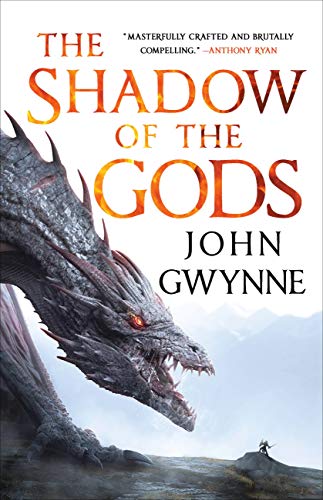
For me, it was impossible not to jump headlong into John Gwynne’s new world, as The Faithful And The Fallen was one of the most pleasant surprises of 2021 for me and it became a part of my favorite fantasy books list.
The Shadow of the Gods takes place in Virgio, the brand new Norse-inspired world of John Gwynne and it has nothing to do with The Banished Lands and as someone who loves Norse mythology, I can say that I had no trouble adapting to this new setting. There were some things that I had a little more difficulty getting used to, which I will talk about in a moment.
The Shadow of the Gods follows a smaller roster of characters compared to The Faithful and the Fallen. We follow Orka, a huntress living in a quiet steading with her husband and son, Varg, a thrall on the run, and Elvar, a warrior who is trying to find where she fits in the world. Each one has a story I enjoyed reading and even more interesting pasts that unfold, step by step. We have three characters that we follow in the book, but still, this is still a John Gwynne novel, so it has a huge cast of characters that we have to get familiar with along the way. This is where my first criticism of the book comes from. All these side characters who accompany the three main characters have both larger and smaller effects on the progression of their respective stories, no problem so far. My problem was that they mostly didn’t have distinctive features that set them apart from others, and they were blending into each other often. Given this large cast of characters, it took me more than usual to remember who is who. I think I will adapt to the second book much more easily but because of this reason immersing myself in the story took me a long, long time, especially compared to Malice, for example, which I thought was difficult for me to get into. But considering the amount of time The Shadow of the Gods required, it was a piece of cake.
“Because I do not know the reason for a thing, does not mean that a dragon-god did it“
Anyone who’s read The Faithful And The Fallen knows that John Gwynne isn’t particularly fond of descriptions. In The Shadow Of The Gods, we see he is being very elaborative about the location descriptions, and this is a wonderful development for visual readers like me. The places we visited in the book are vivid, lived in, and described in a way that is easy to become familiar with. I can’t say the same about the character descriptions. I went more on my own about their physical looks Gwynne is not to blame for this, because no matter how detailed a character is described in a book, they will continue to look like how I pictured them in my mind at first. It’s just the way I’m wired.
But he’s not entirely innocent either. The number of clothing descriptions, in particular, became an issue for me. It’s never a bad thing to describe the clothes of the characters, to create a picture that encompasses their culture, it’s immersive even. But they basically wear the same thing and we read about it every single time! I know this sounds like nitpicking but that was one of the things that killed the pace for me.
“Pride and shame, she thought. Both enemies of a long life.“
There is not much to say about the action in the book. It’s a John Gwynn book. It starts with gripping action and ends with an even greater one. He is a master at making people feel right in the action. It doesn’t matter if the scene he describes is a small banter or a big war; He has an amazing talent that allows him to describe the action scene perfectly, to make you feel like a witness to the event, to make your heart beat faster, and while he is doing all that, he keeps the subject moving at the same time. It is incredible how gifted he is.
“I have always thought it a strange thing, to judge a man or woman by their parentage,” Sulich said, stopping the shaving of his head and sheathing his seax. “Far better to judge them on their deeds, to my mind.“
Let’s talk about Gwynne’s new characters for a bit. As I mentioned before, there is a large cast of characters in The Shadow of the Gods. Some I liked, some I was indifferent in a way I did not expect. When I first started reading Malice, I worried about the characters even when I was at the stage of getting to know them, and I was surprised and saddened not to have the same experience this time. At one point, I couldn’t tell Elvar and Varg apart. To me, at least until the middle of the book, they lacked any defining characteristics or personal development apart from Varg was a slave and Elvar was looking for battle fame. The only character I was truly invested in was Orca. While I wasn’t a huge fan of his first, Varg grew on me in time and I couldn’t wait for Elvar’s chapters to end. Maybe until towards the end. And it wasn’t because her arc wasn’t interesting or anything; I just couldn’t connect with her at all. Interestingly enough, I liked her companions much more than I liked her.
And here is my biggest problem with the book… John Gwynne throws us into this new world with very little explanation of terms and creatures. Lack of glossary is a huge issue here. There was nearly anything, so I had to figure them out from context and it’s not like we rarely see these words throughout the book either. They are always there. I had to google the “veasens” to visualize and I couldn’t find anything! For example, also for the word “brynja”, which we see several times in every chapter. This problem was the biggest reason that prevented me from getting into the book. The reader has to figure out some things from context without explanations to help. To say a mail shirt instead of “brynja” or saying mind or brain rather than “thought cage” would definitely make it easier for me to get into the story. Using words like these a few times is fine, but it gets old and irritating very quickly.
I am still giving it four stars because, in the end, I was very excited to read the rest of the story and definitely gonna pick up the second book when it’s out. It is John Gwynne; I am going to read anything he writes for the rest of my life. But in the end, The Shadow of The Gods feels like it is a huge setup for further installments. So I can recommend going in with tempered expectations.

 Peek-A-Book